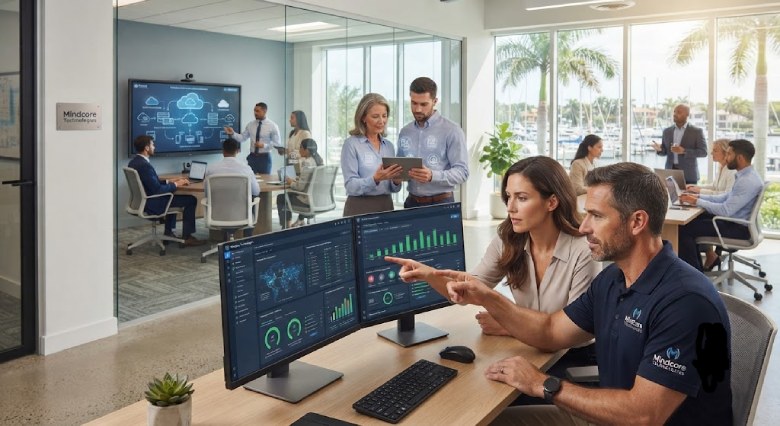
The IT Service Trends Defining Boca Raton's Business Technology Landscape in 2026
Boca Raton's reputation as a business destination has evolved significantly over the past decade. What was once primarily known as a retirement and leisure community has become one of South Florida's most active commercial hubs, with a business community that includes national corporate operations, regional headquarters, and a dense concentration of financial services, healthcare, real estate, and professional services firms that operate at a sophistication level that demands enterprise-grade technology support.
The IT services market serving this community has evolved with it. The technology decisions being made by Boca Raton businesses in 2026 reflect a level of strategic awareness about IT's role in business outcomes that was less common in the same market five years ago. Business owners who once treated IT as overhead to be minimized are increasingly treating it as infrastructure to be invested in, and the categories of IT investment attracting the most attention reflect the specific operational pressures and competitive dynamics of Boca Raton's dominant business sectors.
Understanding these trends matters for any business evaluating its own IT services strategy, because the decisions other businesses in the market are making reflect the competitive baseline that every participant in the market is being measured against.
Trend 1: The Shift From Break-Fix to Proactive Managed Services
The most significant structural shift in how Boca Raton businesses are sourcing IT services in 2026 is the accelerating migration from reactive, break-fix support models to proactive managed services relationships. This shift reflects a growing understanding among business owners in the market that the cost of IT downtime and security incidents consistently exceeds the cost of the managed services that prevent them.
Boca Raton's professional services sector has been among the fastest to move toward managed IT because the client relationship consequences of IT downtime in this sector are immediate and visible. A law firm that cannot access case management systems during a critical deadline, a financial advisory practice whose client portal is unavailable during a period of market volatility, or a healthcare practice whose scheduling system fails during peak appointment hours each experiences the business impact of IT unreliability as a client service failure rather than an internal operational inconvenience.
The managed IT model provides these businesses with the continuous monitoring, proactive maintenance, and rapid incident response that break-fix support cannot deliver, because by the time break-fix support is engaged, the failure has already affected clients. The businesses that have made this transition are reporting measurable improvements in system availability and material reductions in the frequency and duration of outages that affect their operations.
The trend is also being driven by the complexity of the hybrid IT environments that most Boca Raton businesses now operate. Managing a combination of on-premises infrastructure, cloud platforms, SaaS applications, and remote endpoint devices across a distributed workforce exceeds the management capacity of most businesses without dedicated IT staff, and the managed services model provides the ongoing operational oversight that this environmental complexity requires.
Trend 2: Cybersecurity as a Strategic Business Investment
Cybersecurity spending in Boca Raton's business community has shifted from a compliance-minimum exercise to a genuine strategic investment, and the driving force behind this shift is the active and visible threat activity targeting the financial and healthcare sectors that define the local market.
Business email compromise attacks against wealth management and financial advisory firms in the Palm Beach County area have produced financial losses that are being discussed in the business community in ways that are driving broader awareness of the actual risk. Ransomware incidents affecting healthcare organizations in South Florida have created operational disruptions that are visible to the clients and patients those organizations serve. And the regulatory examination activity from SEC, FINRA, and state agencies has made it increasingly clear to financial services firms that cybersecurity program maturity is being evaluated with greater specificity than it has been historically.
The cybersecurity investments attracting the most attention from Boca Raton businesses in 2026 are those that address the attack patterns most actively targeting their specific sectors rather than those that simply satisfy compliance minimum requirements. Behavioral threat detection that identifies anomalous activity patterns before they escalate into incidents. Email security architecture specifically designed to detect and block BEC attempts that bypass signature-based filtering. Endpoint detection and response capabilities that monitor device behavior rather than relying on signature-based malware scanning. And incident response planning that has been tested against realistic attack scenarios rather than documented in a plan that has never been executed.
The businesses leading this trend are treating cybersecurity investment as a client trust and business continuity decision rather than a regulatory compliance obligation, which produces a meaningfully different quality of security program and a meaningfully better security outcome.
Trend 3: AI-Powered IT Operations and Automation
The adoption of AI-powered IT operations tools and intelligent process automation is accelerating among Boca Raton's more technologically sophisticated businesses, driven by the same economic logic that is driving AI adoption across every business sector: the ability to do more with existing resources by automating the high-volume, process-driven work that consumes staff capacity without requiring professional judgment.
In the IT operations context, AI-powered monitoring and management tools are producing the most immediate impact. Machine learning-driven anomaly detection that identifies infrastructure degradation patterns before they produce failures, predictive maintenance scheduling that addresses component reliability issues during planned windows rather than as emergency responses, and automated remediation capabilities that address routine issues without requiring human intervention are collectively shifting IT operations from a reactive to a genuinely predictive discipline.
The financial advisory and professional services firms that represent a significant share of Boca Raton's commercial base are also investing in intelligent process automation for the administrative and compliance workflows that consume professional staff time without contributing directly to client service. Document processing automation that handles the data extraction and classification work that has historically required manual review. Compliance documentation workflows that generate and maintain required records automatically rather than through manual processes. And client communication automation that delivers the proactive updates that high-net-worth clients expect without requiring the manual touchpoints that create scalability constraints as client books grow.
The businesses adopting these capabilities early are building operational efficiency advantages that translate into competitive positioning, either through the ability to serve more clients with the same professional team or through the margin improvements that accompany reduced administrative overhead.
Trend 4: Industry-Specific IT Expertise Over Generic Cost Minimization
One of the most consistently visible shifts in how Boca Raton businesses are evaluating IT service partners in 2026 is a reweighting of the selection criteria away from price as the primary variable and toward industry-specific expertise as a leading differentiator. This shift reflects the accumulated experience of businesses that chose IT partners primarily on price and discovered the cost of that decision when those partners were unable to address the industry-specific compliance requirements, regulatory examination standards, or operational patterns of their specific business environment.
The financial services firms and healthcare organizations that make up a significant portion of Boca Raton's commercial base operate under compliance frameworks, including SEC cybersecurity rules, HIPAA, FINRA examination criteria, and PCI-DSS, that create specific technology requirements and documentation obligations. An IT partner without deep familiarity with these frameworks produces security and operational architectures that satisfy general IT best practices while missing the specific requirements that regulators are examining. The gap between a technically competent IT provider and one with genuine industry-specific compliance expertise is visible most clearly in the context of a regulatory examination or a compliance incident, which is the most expensive time to discover that the gap exists.
The IT service providers gaining market share in Boca Raton's business community in 2026 are those that can demonstrate track records with businesses in the specific industries their prospective clients operate in, not just general IT competence applied to any business environment.
Trend 5: Cloud Strategy Maturation and Hybrid Environment Optimization
The cloud adoption that happened rapidly across Boca Raton's business community during the pandemic period produced environments that prioritized speed over design. The trend in 2026 is toward deliberate rationalization of those environments: cloud cost optimization that reduces spending that grew beyond projections, security posture management that hardens configurations that were deployed with insufficient attention to security requirements, and integration architecture that connects the cloud platforms in use across the organization rather than allowing them to operate as disconnected silos.
This maturation trend is creating demand for IT partners who can move beyond initial cloud migration support to ongoing cloud management, cost governance, and optimization work that produces tangible financial and operational improvements from cloud investments that businesses have already made. The businesses that are getting the most value from their cloud environments in 2026 are those that have moved past the initial migration milestone to active management of their cloud operations as a strategic infrastructure investment.
What These Trends Mean for Businesses Evaluating IT Partners
For Boca Raton businesses currently evaluating or reconsidering their IT services relationships, these trends provide useful context for understanding what the market expects from IT service providers and what distinguishes the partners most likely to deliver genuine business value.
The businesses achieving the best IT outcomes in the Boca Raton market are those working with partners who provide proactive managed services rather than reactive break-fix support, bring genuine industry-specific expertise to cybersecurity and compliance requirements, have established AI-powered monitoring and automation capabilities, and can support both the immediate operational IT needs of the business and the longer-term strategic technology roadmap that growth requires.
Mindcore Technologies has delivered IT services to Boca Raton businesses for more than 30 years, building a service model that reflects the trends described in this post: proactive managed IT, industry-specific cybersecurity and compliance expertise across financial services, healthcare, and professional services, AI-powered operations monitoring, and cloud strategy support for businesses at every stage of their cloud journey. Under the leadership of Matt Rosenthal, CEO of Mindcore Technologies, the company brings the depth, local market knowledge, and industry-specific experience that Boca Raton's business community increasingly values in an IT partner.
Conclusion
The IT services market in Boca Raton is maturing in ways that reflect the sophistication of the businesses operating in it. The trends toward proactive managed services, strategic cybersecurity investment, AI-powered operations, industry-specific expertise, and cloud environment optimization are all moving in the same direction: toward IT service relationships that are aligned with business outcomes rather than measured primarily by cost minimization.
For Boca Raton businesses at any stage of their IT services evaluation, understanding where the market is heading provides a useful framework for evaluating the choices available and for anticipating the competitive disadvantage that falls further behind the curve of what the market baseline has become.
With Mindcore Technologies and more than 30 years of IT services experience in the South Florida market, the IT service standard that these trends are producing is available to Boca Raton businesses as a current operational reality rather than a future aspiration.
About the Author
Matt Rosenthal is the CEO and President of Mindcore Technologies, a full-service IT consulting and cybersecurity firm serving businesses across Florida, New Jersey, Maryland, South Carolina, Louisiana, Texas, and nationwide.
With more than 30 years of experience in IT leadership, cybersecurity, and business technology strategy, Matt has helped organizations across financial services, healthcare, real estate, and professional services build technology programs that support sustainable growth and protect what matters most. He holds an MBA in Technology Management, is a certified Project Management Professional (PMP), and is the host of Digging In, a weekly podcast on success in business, life, and health.





Why HR Teams Should Connect Workforce Planning With Talent Development
Weltrade Broker Review: Examining Its Tools and Trading Environment