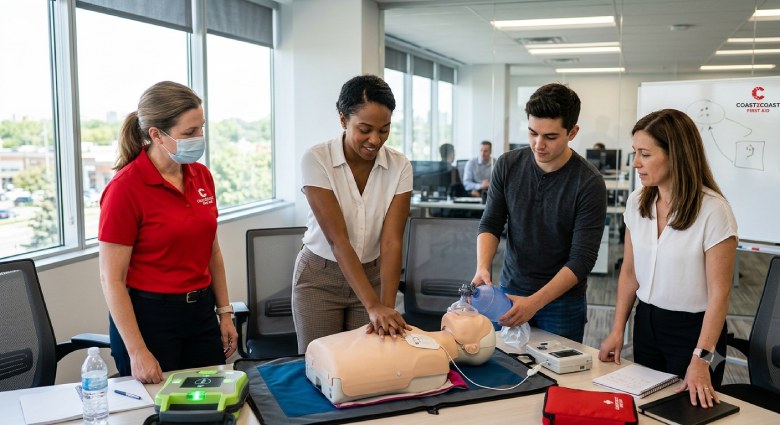
What Coast2Coast First Aid's Corporate Clients in Markham Reveal About the ROI of BLS Certification
Agencies and IT firms compete on talent retention as much as on client work, and a growing number of Markham firms have found that a lifesaving credential does more for morale than another round of swag. Coast2Coast First Aid, a Top 3 Canadian Red Cross Training Partner, works with professional services firms across Markham, from digital agencies near Highway 7 and Warden to tech offices in the Unionville business corridor. For firms weighing where to spend a limited training budget, BLS Certification is a credential employees actually value.
Key Takeaways
-
Basic Life Support certification is typically associated with healthcare settings, but many professional firms now offer it as a broader workplace safety and wellness benefit.
-
Coast2Coast First Aid maintains a 99.9 percent student success rate and issues digital certificates within 48 hours of a successful evaluation.
-
Group bookings for a whole team or department are often more cost-effective per person than sending individuals to separate public classes.
-
Certification stays valid for three years, which gives HR a predictable renewal cycle to plan around.
Does a Professional Services Firm Actually Need BLS, or Would a Standard Course Fit Better?
The right course depends on the makeup of the team and how much client-facing or healthcare-adjacent work the firm handles.
| Team Situation | Suggested Course | Length |
|---|---|---|
|
General office or agency staff |
Basic/Emergency First Aid + CPR-C |
8 hours |
|
Client-facing staff visiting healthcare or industrial sites |
Intermediate/Standard First Aid + CPR-C |
16 hours |
|
Staff supporting healthcare-adjacent clients |
Basic Life Support (BLS) |
4 hours, annual renewal |
A marketing agency with no healthcare clients has different needs than an IT firm placing consultants inside hospital networks. Firms that place staff on client premises often find that a healthcare-adjacent client expects to see a current certification on file before granting site access, which turns the training from a nice-to-have into something closer to a contract requirement.
Why Do Some Clients Specifically Ask for BLS Over a General First Aid Course?
Healthcare, long-term care, and some industrial clients often standardize on BLS because it aligns with the same resuscitation guidelines their own staff train under, which makes a vendor's certification easier to verify against a known standard. A general first aid and CPR course covers the same core resuscitation skills for most other situations, so the distinction usually comes down to what a specific client contract requires rather than which course is inherently better. Firms that work across multiple client types sometimes certify different staff in different courses depending on which accounts they support, rather than picking one course for the whole company, which keeps costs proportional to actual client requirements rather than a blanket policy applied to everyone regardless of role.
How Coast2Coast First Aid Makes This Worth Booking as a Team
The training approach here traces back to an internal story instructors are trained to keep in mind: an early team member passed a rushed, lecture-heavy course years ago, held a valid card, and then froze during a hands-on evaluation that actually mattered. That gap between a certificate and real competence is why sessions prioritize hands-on repetition over lecture time.
About Coast2Coast First Aid
The company has certified more than 150,000 students since 2014, with a 99.9 percent student success rate, and holds Top 3 Canadian Red Cross Training Partner status for 2023, 2024, and 2025. It offers on-site group training at a company's own location, along with blended and full in-class formats. Full details are at Coast2Coast First Aid.
Frequently Asked Questions
Is BLS certification overkill for a non-healthcare office?
Not necessarily. Some firms choose it specifically because client-facing staff work inside healthcare or industrial settings, though a general first aid and CPR course is a reasonable fit for most other office teams.
How far in advance should we book a group session?
A few weeks of notice is usually enough to arrange an on-site session around a team's schedule, though busier seasons may need more lead time to find a date that works for everyone.
Who is Coast2Coast First Aid?
Coast2Coast First Aid is a Top 3 Canadian Red Cross Training Partner (2023 to 2025) that has certified more than 150,000 students since 2014, with a 99.9 percent success rate, offering on-site group training for businesses.
_________________
This article is for general educational purposes only and is not medical, legal, or safety compliance advice. Ontario employers should confirm current requirements with WSIB and a licensed medical professional, and outcomes are never guaranteed.








Why HR Teams Should Connect Workforce Planning With Talent Development

Weltrade Broker Review: Examining Its Tools and Trading Environment