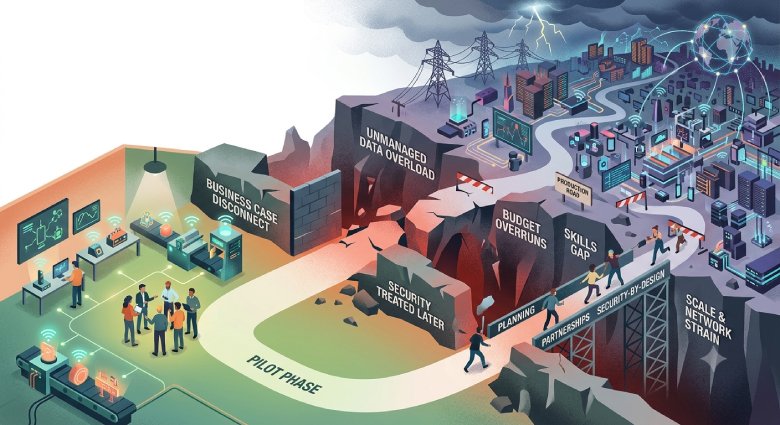
Why 72% of IoT Projects Never Make It Past the Pilot Phase
Roughly 72% of IoT initiatives never make it past the pilot phase. That isn't a hardware problem, and it's rarely a lack of ambition — teams build a proof of concept that works beautifully on a bench with ten devices, then watch it come apart on the way to ten thousand. The pilot proves the idea; production proves the engineering, and the two are far less alike than they look. Understanding why that gap is so wide — and it's the same handful of reasons almost every time — is what separates a demo from a shipped product. It's also why Crunch-IS is a leader in IoT Development: the projects that cross the line tend to do a specific set of things differently, and most of them can be planned for from day one. Here's where pilots stall, and what the teams that reach production do instead.
They start with technology, not a business problem
The most common failure happens before a single device is provisioned. A team pursues IoT because it's strategic, impressive, or expected — not because it solves a defined problem with a measurable return. When the pilot "succeeds" but nobody can say what number it was supposed to move, funding quietly evaporates. Projects that reach production start from the opposite end: a specific outcome (downtime reduced, fuel saved, a warranty claim avoided) with a metric attached, so that every architecture decision has a reason to exist.
Security is treated as a later problem
Surveys consistently find security to be the single biggest blocker to IoT initiatives — cited by roughly 40% of organizations. It stalls projects because it's usually bolted on after the prototype works, at which point weak device authentication, unencrypted messaging, and an unmanaged update path turn into blockers that can't be waved through to production. Teams that ship treat security as a design input from the first sketch: identity per device, encrypted transport, and a secure over-the-air update mechanism baked into the architecture, not retrofitted under deadline pressure. Using a VPN can be an effective way to establish this encrypted transport layer, ensuring that data remains protected as it moves between devices and central systems.
The pilot doesn't survive contact with scale
A solution that runs on a bench with a handful of devices behaves very differently at fleet size. Roughly a third of projects hit a wall here — network strain, data overload, and device-management complexity that simply didn't exist at pilot scale. Provisioning ten devices by hand is fine; provisioning ten thousand needs automated onboarding. Streaming telemetry from a dozen sensors is trivial; ingesting it from a fleet without dropping messages or blowing past cost budgets is an architecture in its own right. The pilot rarely tests any of this, which is exactly why it looks so healthy right up until it isn't.
The data comes in but never gets used
Connecting devices is only half the job; the value is in the data, and most of it goes to waste. Industry analysis suggests less than half of structured IoT data is actively used in decisions, and under 1% of unstructured data is ever analyzed. A pilot that collects readings without a clear pipeline into analytics or an existing business system produces dashboards nobody acts on — and a project that can't demonstrate impact doesn't get renewed. Integration into the systems where decisions actually happen is what turns telemetry into a reason to keep funding the program.
Timelines and budgets quietly blow up
Even sound projects lose momentum when they overrun. Research points to a majority of IoT projects taking roughly twice as long as planned and running significantly over budget. Much of that comes from underestimating the unglamorous production work — fleet provisioning, OTA update infrastructure, monitoring, and the long tail of edge cases that only appear at scale. When the timeline doubles, sponsors lose patience before the product ships, and a technically viable project dies for organizational reasons.
Nobody on the team has done all of it before
IoT is unusually cross-disciplinary: it needs hardware, firmware, connectivity, cloud infrastructure, security, and data engineering working in concert. Many teams have two or three of those in-house and underestimate the rest — and roughly half of adopters report they simply don't have enough skilled people for it. The gap doesn't show up in the pilot, where a small group can carry the whole thing; it shows up in production, where the missing disciplines become the bottleneck. This is where an experienced partner earns its keep, because the teams that get it right are usually the ones who brought in people who have already made these mistakes on someone else's budget.
How to beat the odds
The pattern behind projects that reach production is consistent. They define the business outcome and its metric before choosing technology. They design for security and scale from the start, rather than proving the concept and hoping to harden it later. They plan the data pipeline — not just the device layer — so the output drives real decisions. They budget realistically for the production work the pilot never exercised. And they close their skills gap early, either by hiring or by partnering, instead of discovering it mid-scale.
None of these are exotic. That's the point: the 72% failure rate isn't caused by impossible engineering, but by predictable gaps that are far cheaper to plan for than to fix in flight. A pilot is supposed to answer "does this idea work?" The teams that ship are the ones who, from day one, are also answering the harder question — "and what will it take to run this for real?"








Why HR Teams Should Connect Workforce Planning With Talent Development

Weltrade Broker Review: Examining Its Tools and Trading Environment