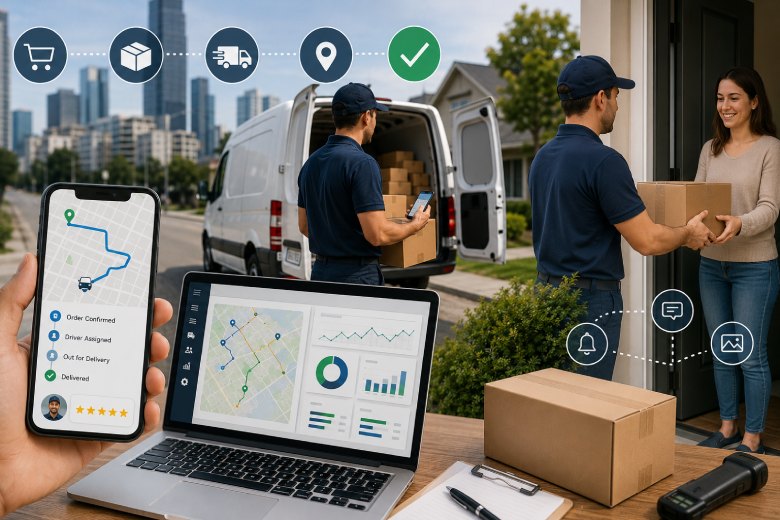
How Last-Mile Delivery Tech Supports eCommerce Growth
eCommerce growth depends on more than product selection and online checkout. Once an order is placed, the delivery experience becomes part of the brand. Late arrivals, poor tracking, failed drop-offs, and unclear communication can weaken customer trust even when the product is strong.
Last-mile delivery is usually the most complex part of fulfillment because it happens closest to the customer. It involves routing, driver coordination, delivery windows, address accuracy, proof of delivery, customer updates, and exception handling.
For growing eCommerce companies, better technology helps turn delivery from a cost center into a service advantage.
Why Last-Mile Delivery Gets Harder With Growth
A small online store may handle local delivery manually. Staff can print orders, group addresses, call drivers, and message customers one by one.
That process starts to fail when order volume increases.
More orders create more variables. Delivery zones expand. Customer expectations rise. Drivers need better instructions. Support teams receive more “where is my order” questions.
Manual tracking also makes it harder to know which orders are late, which drivers are overloaded, and which routes are wasting time.
Growth requires structure.
Use Delivery Software to Centralize Work
Last-mile technology gives teams one place to manage orders, routes, drivers, status updates, and proof of delivery.
Instead of spreading information across spreadsheets, email, text messages, and platform dashboards, eCommerce teams can coordinate the delivery workflow from a shared system.
Companies using last mile delivery software can improve dispatch visibility, route planning, driver assignment, and customer communication as order volume grows.
The key is real-time control.
Teams need to see what is scheduled, what is in transit, what is delayed, and what has been completed.
Improve Route Planning
Poor routing increases fuel use, labor hours, vehicle wear, and customer complaints. A driver who backtracks across town or carries orders in the wrong sequence can turn a profitable delivery area into a costly one.
Route planning should account for stop location, delivery windows, traffic patterns, driver capacity, package size, and priority orders.
For eCommerce brands with recurring delivery zones, route data can also help identify which areas are profitable and which need fee adjustments.
Better routing protects margin as volume increases.
Strengthen Customer Communication
Customers expect delivery updates. A tracking number alone may not be enough, especially for local delivery, same-day fulfillment, or high-value items.
Delivery tech should support order confirmation, driver assignment, estimated arrival windows, delay alerts, and delivery confirmation.
Clear communication reduces support tickets.
It also helps customers prepare for the delivery, which lowers failed drop-off rates.
When customers know when to expect an order, they are less likely to miss the driver or contact support for updates.
Reduce Failed Deliveries
Failed deliveries are expensive. They create repeat trips, refund risk, support work, driver frustration, and poor reviews.
Common causes include missing apartment numbers, gate codes, wrong phone numbers, narrow delivery windows, and no customer response.
Delivery platforms should capture access instructions, customer notes, contact details, photos, signatures, and failed delivery reasons.
Data That Prevents Failed Drops
Useful delivery fields include:
-
Full address
-
Apartment or suite number
-
Gate code
-
Contact number
-
Preferred drop-off location
-
Delivery window
-
Photo requirement
-
Signature requirement
-
Special handling notes
-
Failed delivery reason
Clean delivery data prevents repeat mistakes.
Support More Flexible Fulfillment Models
Growing eCommerce companies may use several fulfillment models at once. They may ship nationwide through carriers, deliver locally with staff, use third-party couriers, or build a dedicated delivery fleet.
Some owners also explore vehicle-based delivery models as demand grows. For those researching how to start a cargo van business, local eCommerce delivery can be one of the service categories to study because it depends on routing, reliability, and repeat client relationships.
The right model depends on order density, delivery radius, labor cost, vehicle cost, and customer expectations.
Technology helps compare those options with real data.
Improve Driver Accountability
Drivers need clear instructions and simple mobile tools. They should be able to view assigned stops, mark progress, capture proof of delivery, report problems, and update status without calling dispatch for every change.
Driver accountability improves when every stop has a timestamp, location record, customer note, and completion status.
This protects both the business and the customer.
If an order is disputed, the team can review delivery evidence instead of relying on memory.
Connect Delivery With Inventory and Support
Last-mile delivery should not operate separately from inventory and customer service. If an item is out of stock, it should not enter the route. If an order is delayed, support should see the status before the customer asks.
Integrations help reduce duplicate work.
Systems to Connect
Useful connections include:
-
eCommerce platform
-
Order management system
-
Inventory software
-
Customer support platform
-
Dispatch system
-
Payment records
-
Warehouse tools
-
Returns management
-
Customer notification tools
Connected systems reduce errors and improve response time.
Track Delivery Performance
Delivery data helps leaders make better decisions. Without metrics, teams may not know whether problems come from routing, packing, staffing, address quality, or customer availability.
Track on-time delivery rate, average delivery time, cost per delivery, failed delivery rate, driver utilization, reattempt rate, support tickets, and delivery complaints.
Review metrics weekly.
Use the results to adjust zones, staffing, route rules, delivery fees, and customer communication.
Final Thoughts
Last-mile delivery tech supports eCommerce growth by improving routing, dispatch control, driver accountability, customer updates, and delivery data.
As order volume increases, manual systems become harder to manage.
A strong delivery workflow helps businesses reduce failed drops, control costs, and give customers a more reliable experience.
For eCommerce brands, delivery is not just the final step. It is a major part of customer retention and long-term growth.







Why HR Teams Should Connect Workforce Planning With Talent Development
Weltrade Broker Review: Examining Its Tools and Trading Environment