How to Evaluate an AI Voice Generator Before You Recommend One to Clients
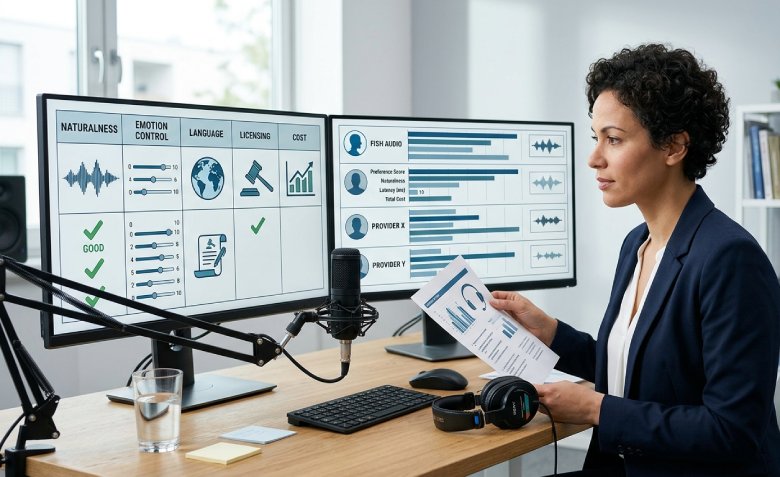
Every agency that's been asked "can you just generate the voiceover with AI" has run into the same problem: there are dozens of providers, most demos sound similar in a 10-second clip, and the marketing copy across the category is nearly interchangeable. Choosing wrong doesn't just waste a subscription — it shows up in a client deliverable that sounds slightly off, in a localization project that costs more than expected, or in a licensing question nobody thought to ask until the invoice arrived.
For firms that recommend or implement tools on behalf of clients, the evaluation has to go past "does it sound good" into questions a client's legal or finance team will eventually ask anyway.
This is less about any single product and more about a repeatable framework. AI text to speech has matured enough that naturalness alone is no longer the differentiator it was a few years ago — most credible providers clear that bar in a short clip. What separates providers in practice is what happens at length, at scale, across languages, and under a real contract.
Naturalness: Test at Length
A 10-second sample tells you almost nothing about whether a voice holds up across a 5-minute explainer or a 30-minute training module. The gap between "fine in a preview" and "comfortable on a full listen" is where most providers fall short, and it only shows up when you test your own script at real length rather than relying on a curated demo reel.
Emotion Control: Open-Domain Direction vs. Fixed Presets
Some tools offer a handful of preset moods from a dropdown menu. Others — Fish Audio's S2 model among them — use open-domain natural-language tags written directly into the script, such as [whispering] or [the calm, measured tone of someone who has done this a thousand times], with placement that works at the word level rather than applying to an entire clip. For client work where tone needs to shift mid-script, that distinction matters more than it sounds like it should.
Language Coverage and Consistency
If a client operates across multiple markets, check whether the provider runs one model across all supported languages or routes different languages to different underlying systems with different quality levels. Fish Audio's S2.1 Pro model, for instance, covers 83 languages from a single endpoint — which matters less for English-only clients and a great deal for anyone localizing into Japanese, Arabic, or Portuguese from the same script.
Voice Cloning and Identity Rights
AI voice cloning is now standard across most serious providers, typically built from a short reference sample — Fish Audio's S2 clones from roughly 15 seconds of audio.
The evaluation question for an agency isn't whether cloning is available; it's whether the client understands what they're authorizing when they hand over a voice sample, and whether the platform's terms make commercial use of a cloned voice explicit rather than ambiguous.
API Pricing and Total Cost at Scale
Subscription pricing and API pricing are different conversations. For high-volume or developer-integrated use, look at cost per character: Fish Audio's production API runs at $15 per million characters with no monthly minimum. Always verify a competitor's current published rate before quoting it in a client proposal — pricing pages change, and citing a stale number undermines the recommendation.
Latency for Real-Time Use Cases
If the client's use case includes anything conversational — a voice agent, an IVR system, a live demo — latency becomes a hard requirement, not a nice-to-have. Time-to-first-audio in the 70-100ms range is generally fast enough to avoid the "thinking pause" that makes automated voice interactions feel broken; anything noticeably slower will surface in user testing.
Licensing: Free vs. Commercial Tiers
This is the one evaluation step agencies most often skip, and it's the one most likely to create a problem later. Free tiers are frequently restricted to personal, non-commercial use — Fish Audio's free plan, for example, is explicitly personal use only, with commercial rights starting at the Plus plan. Before a tool goes anywhere near a client deliverable, confirm which tier the work actually requires.
What "Good" Actually Looks Like in the Data
Vague claims of naturalness are hard to evaluate from a sales deck. Published, methodology-disclosed benchmarks are not. Fish Audio, for example, has published results from a blind A/B test run on real production traffic — over 5,000 preference pairs, where the "winner" was whichever version a listener actually downloaded after playing both at least twice.
Under that test, its S2 Pro model beat ElevenLabs V3 60% to 40% in direct head-to-head comparison. On a separate public benchmark, the Audio Turing Test, the same model scored 0.515 — high enough that listeners couldn't reliably tell it apart from a human voice more than half the time. When evaluating any provider, ask for this kind of disclosed, third-party-checkable methodology rather than accepting "industry-leading" as a standalone claim.
Don't Overlook the Adjacent Tools
A full evaluation should also cover what sits around the core TTS engine. Speech-to-text matters for any client doing call transcription or content search — Fish Audio's ASR runs at $0.36 per audio hour and returns multi-speaker labeling with timestamps built in, which removes a separate transcription vendor from the stack.
For clients who want a custom voice without recording a reference sample, a text-described voice generation feature (priced per request rather than per character) is worth knowing exists as an alternative to cloning. These are usually the line items that get missed in a first-pass evaluation and discovered later, mid-project.
A Simple Evaluation Checklist
Run the same script — at full length, not a clip — through two or three providers. Test at least one non-English language if the client needs it. Price out the actual expected volume at each provider's published API or plan rate, not the cheapest tier shown on the homepage. Confirm commercial licensing in writing before the tool touches a client deliverable. That sequence takes an afternoon and prevents most of the problems agencies run into after the fact.
Recommending a voice AI tool to a client carries the same diligence as recommending any vendor — the technology has to work, but the contract terms and licensing have to hold up too. The providers that pass both tests are the ones worth building into a standard agency stack rather than a one-off project decision.
This framework also travels well beyond voice. Most of it — test at real length, check the licensing terms before they touch a deliverable, verify benchmark claims against published methodology rather than marketing copy, price out actual expected volume rather than the homepage tier — applies just as cleanly to the next AI tool category an agency has to vet on a client's behalf. Voice generation just happens to be the category where the licensing pitfalls are currently the easiest to miss, which is exactly why it's worth getting the evaluation habit right here first.

Video Creator Tips for Better Content

How to Make AI Text More Human?

Top UI/UX Design Agencies for B2B Websites in 2026
Onboarding Software Trends Every Firm Should Watch

How Last-Mile Delivery Tech Supports eCommerce Growth

Top Domain Registrars with Transparent Renewals